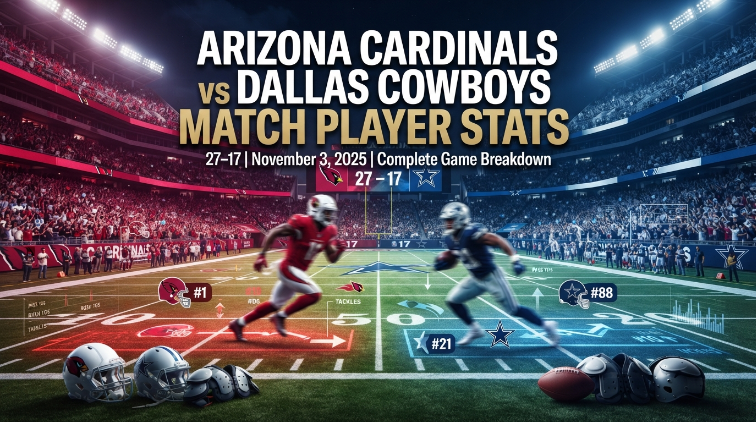
The Arizona Cardinals vs Dallas Cowboys match player stats from November 3, 2025, tell the story of a game decided by efficiency, turnovers, and timely defensive plays. Arizona walked into AT&T Stadium and left with a convincing 27-17 victory, ending the contest with advantages in total yards, passing production, first downs, and most importantly, turnovers.
Jacoby Brissett delivered an efficient performance for Arizona, while Marvin Harrison Jr. and Trey McBride produced touchdowns through the air. Dallas generated productive numbers from Dak Prescott, CeeDee Lamb, George Pickens, and Javonte Williams, but three turnovers and several missed opportunities kept the Cowboys from controlling the game.
| Statistic | Arizona Cardinals | Dallas Cowboys |
|---|---|---|
| Final Score | 27 | 17 |
| Total Yards | 340 | 333 |
| Passing Yards | 221 | 210 |
| Rushing Yards | 119 | 123 |
| First Downs | 23 | 22 |
| Turnovers | 0 | 3 |
| Sacks Allowed | 5 | 5 |
| Time of Possession | 33:20 | 26:40 |
How Arizona Cardinals Controlled the Game
Jacoby Brissett Sets the Tone
Brissett was one of the central figures in Arizona’s victory. He completed a productive passing performance for 261 yards and two touchdowns without throwing an interception. His reported 115.1 quarterback rating reflected his ability to create scoring opportunities while avoiding the costly mistakes that affected Dallas.
The quarterback also contributed on the ground, carrying the ball five times for four yards and a touchdown. Although his rushing average was modest, the score added another dimension to Arizona’s offensive attack.
One important detail was protection. Brissett was sacked five times, yet he continued to produce efficiently when given opportunities to operate the passing game.
Emari Demercado Provides Efficient Rushing
Emari Demercado led Arizona’s rushing attack with 14 carries for 79 yards. His 5.6 yards per carry demonstrated strong efficiency, and his longest run covered 19 yards.
Zonovan Knight added nine carries for 27 yards, while Brissett contributed his rushing touchdown. Together, the Cardinals established enough ground production to prevent Dallas from focusing exclusively on the passing game.
Arizona’s Receiving Leaders
Marvin Harrison Jr. Makes a Major Impact
Marvin Harrison Jr. emerged as one of Arizona’s most productive offensive players. He finished with seven receptions for 96 yards and a touchdown on 10 targets.
His combination of volume and efficiency gave Brissett a reliable downfield option. Harrison’s production also helped Arizona maintain pressure on a Dallas defense that needed to account for multiple receiving threats.
Trey McBride Adds a Touchdown
Trey McBride caught five passes for 55 yards and also reached the end zone. He received nine targets, highlighting his importance within Arizona’s passing structure.
Michael Wilson contributed three receptions for 61 yards on four targets, while Elijah Higgins added three catches for 30 yards. The distribution meant Dallas could not simply concentrate defensive attention on one receiver.
Arizona’s Defense Creates the Difference
Sweat and Campbell Pressure Prescott
Josh Sweat and Calais Campbell each recorded two sacks and two tackles for loss. Their combined pressure helped disrupt Dallas’ offensive rhythm and forced Prescott to operate under considerable pressure.
The fact that both teams allowed five sacks shows that neither offensive line consistently controlled the line of scrimmage. However, Arizona’s defensive pressure was particularly important because Dallas had difficulty turning its possessions into touchdowns.
Denzel Burke Delivers a Critical Interception
Denzel Burke recorded an interception of Prescott, providing Arizona with one of the game’s most important defensive moments.
That takeaway was part of a larger difference in ball security. Arizona finished the game without a turnover, while Dallas committed three. In a 10-point game, that margin proved decisive.
Chad Ryland Converts His Opportunities
Chad Ryland made both of his field-goal attempts, including a 48-yard kick, and converted all three extra-point attempts. His reliable kicking performance ensured Arizona converted its scoring opportunities into points.
Dallas Cowboys Offensive Performance
Dak Prescott Produces Yardage but Struggles With Turnovers
Dak Prescott finished with 250 passing yards, one touchdown, and one interception. His 77.9 quarterback rating was considerably lower than Brissett’s mark.
Prescott also carried the ball four times for 34 yards, an impressive 8.5-yard rushing average. His mobility created additional yardage, but it could not offset the problems created by turnovers and pressure.
Five sacks allowed added another challenge for the Dallas passing attack. Arizona’s defensive front consistently created difficult situations for the Cowboys quarterback.
Javonte Williams Leads Dallas on the Ground
Javonte Williams recorded 15 carries for 83 yards, averaging 5.5 yards per attempt. His longest runs helped Dallas maintain a respectable rushing attack, and the Cowboys actually finished with 123 rushing yards compared with Arizona’s 119.
However, Williams also lost a fumble. That mistake became particularly damaging because Arizona protected the football throughout the contest.
Dallas Receiving Leaders
CeeDee Lamb Leads in Receptions and Targets
CeeDee Lamb caught seven passes for 85 yards on 12 targets. His workload demonstrated how heavily Dallas relied on its established receiving threat.
Despite the volume, Lamb did not record a touchdown, limiting the overall impact of his yardage production.
George Pickens Provides Another Reliable Option
George Pickens finished with six receptions for 79 yards on nine targets. His production gave Prescott another productive outlet and helped Dallas accumulate 210 passing yards.
Jake Ferguson added five receptions for 50 yards but also lost a fumble. Ryan Flournoy caught two passes for 12 yards and recorded Dallas’ only receiving touchdown among the listed leaders.
The Cowboys therefore generated several respectable individual performances without converting enough possessions into points.
Why the Turnover Battle Mattered
The most revealing number in the Arizona Cardinals vs Dallas Cowboys match player stats may be the turnover column.
Arizona committed zero turnovers. Dallas committed three, including an interception and two lost fumbles. That created extra opportunities for the Cardinals while removing possessions from Dallas.
The teams were relatively close in almost every major yardage category:
- Arizona led total yards 340-333.
- Dallas led rushing yards 123-119.
- Arizona led passing yards 221-210.
- Arizona had 23 first downs compared with Dallas’ 22.
- Both teams surrendered five sacks.
Those numbers show that this was not a game dominated by overwhelming yardage superiority. Instead, Arizona made better use of its opportunities and protected the football.
Special Teams and Defensive Contributions
Special teams also contributed to the final margin. Ryland went 2-for-2 on field goals for Arizona and added three extra points. Brandon Aubrey converted one of two field-goal attempts for Dallas and made both extra points.
On defense, Dallas received sacks from Jadeveon Clowney and Kenny Clark, who each recorded one sack and two tackles for loss. Those plays helped limit Arizona’s offense, but the Cowboys could not generate enough complementary production to overcome their mistakes.
What the Game Revealed About Both Teams
Arizona’s Strengths
Arizona’s victory was built around several complementary elements:
- Efficient quarterback play from Brissett
- Strong receiving production from Harrison and McBride
- Efficient rushing from Demercado
- Consistent defensive pressure
- A clean turnover sheet
- Reliable kicking
The Cardinals did not need to dominate every statistical category. Their balance allowed them to maintain control for 33:20 of possession.
Dallas’ Main Problems
Dallas had enough offensive production to remain competitive, but several issues prevented a comeback.
The Cowboys lost the turnover battle 3-0, surrendered five sacks, and scored only 17 points. Their rushing attack was productive, yet mistakes from Williams and Ferguson added to Prescott’s interception.
The Cowboys also possessed the ball for only 26:40, giving Arizona more opportunities to dictate the game’s tempo.
Looking Ahead to the Next Cardinals-Cowboys Meeting
The teams are scheduled to meet again during the 2026 preseason on August 22. A preseason matchup should be evaluated differently from the November 2025 regular-season contest because playing time, roster competition, and quarterback rotations can significantly affect individual statistics.
The earlier game nevertheless provides a useful reference point. Arizona demonstrated that pressure defense, turnover avoidance, balanced offense, and efficient red-zone execution can overcome relatively close yardage totals.
For Dallas, the clearest lesson is equally straightforward: productive individual statistics do not necessarily translate into victory when turnovers and stalled scoring drives erase the value of those yards.
Final Takeaway
The Arizona Cardinals vs Dallas Cowboys match player stats from November 3, 2025, reveal a tightly contested statistical battle with a decisive difference in execution. Arizona produced 340 total yards, held the ball longer, committed no turnovers, and received strong performances from Brissett, Harrison, McBride, Demercado, Sweat, Campbell, and Burke.
Dallas generated 333 total yards and received strong contributions from Prescott, Williams, Lamb, and Pickens. Yet three turnovers and inconsistent scoring efficiency ultimately proved too costly.
The 27-17 final score therefore reflects more than a simple yardage advantage. Arizona won the critical moments, protected possession, pressured the quarterback, and converted its opportunities. Those details explain why the Cardinals left AT&T Stadium with the victory despite the relatively narrow statistical gap between the two teams.
Frequently Asked Questions
Who was Arizona’s leading passer?
Jacoby Brissett led Arizona with 261 passing yards, two touchdowns, and no interceptions.
Who led the Cardinals in rushing?
Emari Demercado led Arizona with 79 rushing yards on 14 carries, averaging 5.6 yards per carry.
Who was Arizona’s leading receiver?
Marvin Harrison Jr. led the Cardinals with seven receptions for 96 yards and one touchdown.
How many turnovers did each team commit?
Arizona committed zero turnovers, while Dallas committed three.
Who led Dallas in receiving?
CeeDee Lamb led the Cowboys with seven receptions for 85 yards on 12 targets.
What was the final score?
The Arizona Cardinals defeated the Dallas Cowboys 27-17 on November 3, 2025.