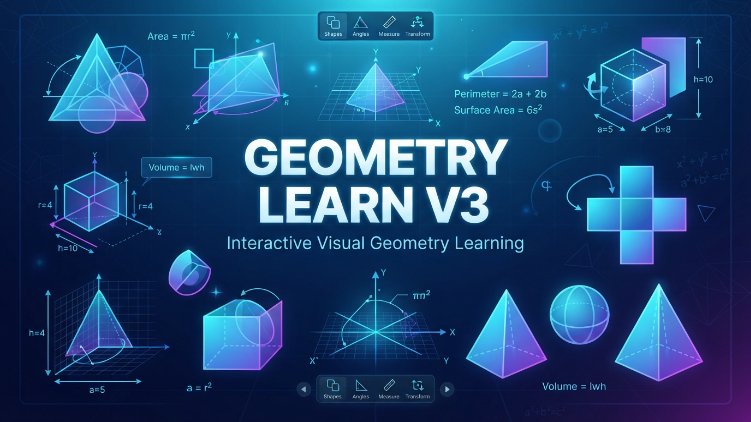
Geometry becomes much easier when abstract ideas can be seen, manipulated, and tested rather than memorized from a page. Geometry Learn V3 takes this approach by combining visual mathematics, interactive activities, and game-inspired challenges to help learners understand shapes, angles, measurements, and spatial relationships. Its central idea is simple: learners can build stronger geometric intuition when they actively explore mathematical concepts.
| Key Area | What It Covers |
|---|---|
| Learning style | Interactive and visual |
| Core subjects | Shapes, lines, angles, measurement |
| Geometry levels | 2D and 3D concepts |
| Practical skills | Area, perimeter, surface area, volume |
| Interactive activities | Angle estimation, symmetry, coordinates |
| Main learning goal | Spatial reasoning and geometric understanding |
What Is Geometry Learn V3?
Geometry Learn V3 is an interactive digital learning platform centered on visual and practical geometry. Rather than presenting geometry entirely through definitions and formulas, its learning model emphasizes exploration.
This distinction matters because geometry is fundamentally spatial. Students need to understand how figures relate to one another, how angles behave, how dimensions change, and how formulas describe real geometric properties.
An interactive environment can make these relationships easier to recognize. Instead of seeing a triangle simply as a diagram with three sides, learners can examine different triangles, compare their angles, and connect those observations with formal classifications.
The platform is therefore particularly relevant to students, beginners, and independent learners who benefit from seeing mathematical ideas represented visually.
Learning Geometry Through Shapes
Understanding 2D and 3D Figures
Shapes provide the foundation for almost every later geometry concept. Geometry Learn V3 approaches this area by distinguishing between planar figures and three-dimensional solids.
Two-dimensional geometry includes figures such as:
- Triangles
- Squares and rectangles
- Parallelograms
- Trapezoids
- Polygons
- Circles
Three-dimensional geometry extends those ideas into solid objects, including cubes, cuboids, cylinders, cones, and other spatial forms.
Classification becomes more meaningful when students understand why a figure belongs to a particular category. For example, triangles can be classified according to side lengths as equilateral, isosceles, or scalene, while angle measurements create another classification system involving acute, right, and obtuse triangles.
This type of comparison develops visual recognition while reinforcing mathematical vocabulary.
Exploring Lines and Angles
From Line Segments to Spatial Relationships
Lines are another essential building block of geometry. Learners need to distinguish among lines, rays, and line segments before moving into more advanced relationships.
Interactive visualization can make these differences much clearer. A line extends indefinitely in both directions, a ray begins at one point and continues indefinitely in one direction, while a line segment has two endpoints.
Geometry also depends heavily on relationships between lines. Important concepts include parallel, perpendicular, and intersecting lines. In three-dimensional settings, learners may also encounter skew lines, which do not intersect and are not parallel because they exist in different spatial planes.
Making Angle Types Easier to Recognize
Angles become easier to understand when their size and orientation can be observed directly.
Common angle types include:
- Acute angles measuring less than 90 degrees
- Right angles measuring exactly 90 degrees
- Obtuse angles measuring more than 90 degrees but less than 180 degrees
- Straight angles measuring 180 degrees
Related concepts such as adjacent angles, vertical angles, and complementary or supplementary relationships can then be introduced using visual examples.
Activities involving angle estimation are especially useful because they encourage learners to develop an internal sense of geometric magnitude rather than relying exclusively on calculation.
Connecting Geometry With Formulas
Understanding Area and Perimeter
One of the biggest challenges in elementary and intermediate geometry is moving from visual recognition to mathematical measurement.
Perimeter describes the distance around a two-dimensional figure, while area measures the amount of space contained within it. These concepts are connected but represent different quantities.
For example, a rectangle with length and width can be evaluated using:
Perimeter = 2 × (length + width)
Area = length × width
Interactive learning can help students see why these formulas work instead of treating them as isolated equations to memorize.
Extending Measurement Into Three Dimensions
Three-dimensional geometry introduces additional measurements, particularly surface area and volume.
Surface area represents the total area covering the outside of a solid, while volume measures the amount of three-dimensional space it occupies.
A cube, for instance, has six equal square faces. Understanding that structure makes its surface-area formula more intuitive:
Surface Area = 6 × side²
Similarly, the volume of a rectangular prism can be understood as the number of cubic units contained within its length, width, and height:
Volume = length × width × height
Spatial visualization is particularly valuable here because students must move from thinking about flat figures to imagining objects with depth.
How Gamified Activities Support Learning
Turning Practice Into Active Problem Solving
Game-inspired learning can change the experience of practicing mathematics. Instead of repeatedly completing similar exercises, learners can encounter challenges that require observation, comparison, estimation, and decision-making.
Geometry Learn V3 incorporates activities associated with visual reasoning, including symmetry matching, angle estimation, and coordinate mapping.
These exercises can reinforce several skills at once. A symmetry challenge, for example, requires learners to recognize balance and spatial correspondence. Coordinate activities encourage them to understand how positions can be represented numerically.
The goal is not simply to make mathematics entertaining. Well-designed interactive exercises can provide immediate opportunities to apply a concept and identify misunderstandings.
Why Visual Geometry Can Be Effective
Geometry often creates difficulty because students are expected to translate between words, diagrams, formulas, and abstract relationships.
Visual learning can reduce some of that cognitive distance.
A learner studying perpendicular lines can see the 90-degree relationship directly. Someone exploring symmetry can manipulate or compare corresponding parts of a figure. A student working with coordinates can connect numerical pairs to actual positions on a grid.
This combination of visual representation and active experimentation supports spatial reasoning, which is useful far beyond a single geometry lesson.
Spatial skills can also contribute to understanding graphs, technical drawings, architecture, engineering concepts, computer graphics, and other areas where objects and relationships must be interpreted visually.
Geometry Learn V3 Compared With Other Visual Resources
Geometry Learn V3 is not the only digital approach to interactive geometry. Several established educational tools use visualization in different ways.
GeoGebra Geometry
GeoGebra is widely known for dynamic mathematics and allows learners to construct points, lines, circles, polygons, graphs, and geometric relationships. Its construction-based approach can be particularly useful for students who want to experiment with mathematical objects and investigate geometric proofs.
SplashLearn Geometry
SplashLearn focuses heavily on younger learners and uses colorful, game-oriented activities to introduce geometry concepts. Its material includes topics such as shapes, lines, quadrilaterals, and other foundational ideas appropriate for elementary-level mathematics.
Math Games Geometry
Math Games provides geometry practice covering topics across multiple school levels. Its activities include areas such as perimeter, area, shapes, angles, and related mathematical skills.
The main difference among these resources is the learning experience they prioritize. Some emphasize open-ended construction, others focus on structured practice, and others place greater emphasis on gamified repetition.
Building Stronger Geometry Skills
Interactive tools are most effective when learners use them as part of a broader learning process.
A productive geometry routine can include:
- Observe the figure before calculating anything.
- Identify known measurements and geometric relationships.
- Choose an appropriate formula rather than applying one automatically.
- Visualize the result and consider whether it makes sense.
- Explain the reasoning in words or through a diagram.
- Practice variations of the same concept using different figures.
This process helps separate genuine understanding from formula memorization.
The Future of Interactive Geometry Learning
Digital mathematics platforms are increasingly capable of presenting concepts through dynamic diagrams, instant feedback, adaptive exercises, and interactive simulations. Geometry is especially well suited to these approaches because so many of its principles depend on visual relationships.
The future of geometry education is therefore likely to combine traditional mathematical reasoning with richer digital representations. Technology should not replace mathematical thinking; instead, it can provide additional ways for learners to see and investigate the ideas behind the mathematics.
Geometry Learn V3 reflects this broader shift toward learning through interaction. By bringing shapes, angles, measurements, coordinates, and spatial challenges into a more visual environment, it offers a practical way to explore concepts that can otherwise feel abstract.
Final Thoughts
Geometry Learn V3 presents geometry as something to explore rather than simply memorize. Its emphasis on shapes, lines, angles, measurements, spatial relationships, and interactive challenges can help learners connect mathematical formulas with the visual properties those formulas describe.
For beginners, this approach can make foundational concepts easier to recognize. For students already familiar with geometry, visual exercises can provide additional practice in spatial reasoning and problem solving.
The most important benefit of interactive geometry is ultimately not learning one more formula. It is developing the ability to look at a figure, understand its relationships, reason about its dimensions, and explain why a mathematical result makes sense.
Frequently Asked Questions
What is Geometry Learn V3 used for?
Geometry Learn V3 is designed to support geometry learning through interactive and visual activities covering shapes, lines, angles, measurements, coordinates, symmetry, and spatial reasoning.
Can it help with 3D geometry?
Its learning approach includes three-dimensional concepts such as solids, surface area, and volume, helping learners connect formulas with spatial structures.
What geometry skills can interactive activities develop?
Activities involving angles, symmetry, coordinates, and shape classification can strengthen visual recognition, estimation, spatial reasoning, and problem-solving skills.
Is visual learning useful for geometry?
Yes. Geometry relies heavily on spatial relationships, so diagrams, dynamic representations, and interactive exploration can make abstract concepts easier to understand.
What are alternatives to Geometry Learn V3?
GeoGebra Geometry, SplashLearn Geometry, and Math Games Geometry are examples of digital resources that use visual or interactive approaches to teach different areas of geometry.